

Nook Review - Page 2
PDF Functionality
The Nook is designed mostly for EPUB and PDB files; don't buy it if you intend on reading a lot of PDF files. Basic text-based PDF ebooks don't even fair too well. The Nook reflows PDFs on all text sizes except small, where it retains the original layout but is too small to read. And for some reason everything is pushed to the left.
The reflow process rearranges formatting and layout and is generally unpredictable; you may end up with strange cut-offs and pages with few or no words. Images disappear and sometimes overlap.
Note: You cannot change font type with PDF files. Also, adding notes, highlighting, and the dictionary functions don't work with PDF files.
LCD Touchscreen Navigation, Menu System
The color LCD section uses the same technology as the iPhone. This allows for touchscreen navigation through menus, annotating, highlighting, page-turning, and typing in searches with an on-screen keyboard.
The LCD screen dims after 10, 30, or 60 seconds of inactivity, whichever you choose. And the screen brightness is adjustable too.
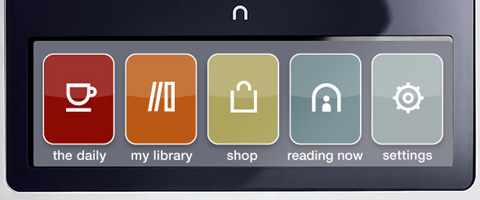
The touch sensitivity takes some getting used to at first. It requires very specific types of tapping and swiping to register. To turn pages, brush the surface of the screen as light as possible. Any slight pressure and it won't work.
Overall, the touchscreen's most prominent feature is showing color book covers, which works quite well. They say you can't judge a book by its cover. But I disagree. You can tell a lot from a cover, most specifically what genre it belongs too, and that makes browsing through them somewhat easier.
Notes, Highlighting, and Dictionary
For reasons unknown, some ebooks tend to work better than others for these three features, and some plain don't work at all, despite them all being in EPUB format.
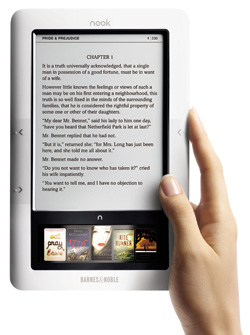
Regardless, highlighting, note-taking, and the dictionary are all very slow to use and not very effective even when they do work properly. The cursor is simply too slow and jumpy; it would take 2 minutes to get to a word at the bottom-right of the screen.
Notes must be anchored to a highlight, and moving the cursor for the highlight is just as slow and painful as with the dictionary.
For a couple of ebooks I tried, the dictionary would freeze up and display this error message: Sorry! Activity Reader (in application Reader) is not responding. Force close, Wait.
The on-screen keyboard works very well for typing, even with large fingers hitting the right button isn't much of a problem, but there is no separate notes application; a note can only be tied to a highlight within a book.
Battery Life
So far battery life hasn't been good. 1-2 days with wireless turned on and in use periodically. 4-5 days with wireless turned off. Sometimes batteries need time to calibrate properly when new, so hopefully battery life will improve somewhat.
Conclusion
The Nook has potential, but is still a work in progress. Its best features are its screen quality, ability to lend ebooks, support for Adobe DRM allows content from other stores as well as free library ebooks, and its appealing design. B&N's competitive ebook prices are also a plus.
If you can live without advanced note-taking and PDF support, and are fan of Barnes and Noble and like shopping there, then the Nook may be worth your consideration.
Meanwhile, most of this review that you just read means nothing if you choose to root your Nook and install a hack from nookdevs. The Nook's Android operating system is highly hackable, and can be opened up to all kinds of applications.
Feature List
- 6-inch E Ink Screen.
- 16 levels of grayscale.
- 5 text sizes and 3 font types.
- Adobe DRM compatible.
- 3.5-inch color LCD touchscreen.
- Free wireless via AT&T's 3G network.
- Built-in 802.11b/g Wi-Fi and free Wi-Fi at Barnes and Noble retail stores (no browser, though).
- 2 GB internal storage (1500 ebooks).
- Micro SD expansion slot up to 16 GB (17,500 ebooks).
- Built-in Merriam-Webster’s New Oxford Collegiate Dictionary.
- Sync between devices.
- Lend purchased ebooks between friends on any B&N compatible device for 14 days.
- Android operating system.
- Battery life: 10 days with wireless turned off.
- User replaceable battery.
- Built-in speaker and headphone jack.
- Dimensions: 7.7" tall x 4.9" wide x 0.5" thick.
- Weight: 12.1 ounces (343 grams).


